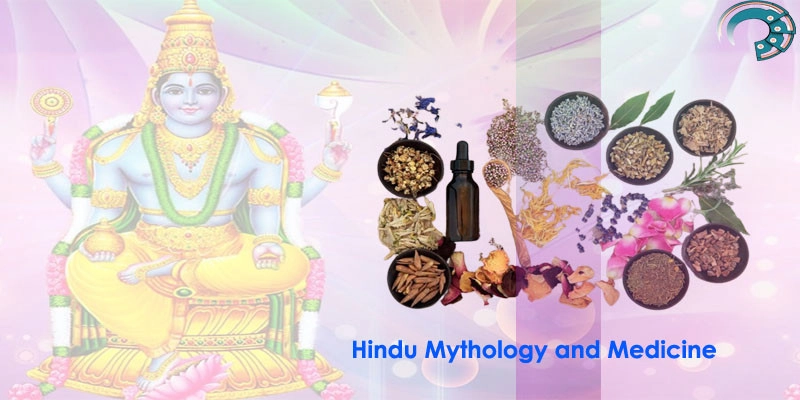
Hindu mythology and medicine
Hinduism is one of the oldest religions in the world and has millions of worshippers both in India and around the globe. It has been compiling the heroic epics and sacred stories that make up Hinduism's mythology for well over 3,000 years. In this intricate and vibrant mythology, nothing is set in stone. It alters and transforms as creation, destruction, love, and war pulse through it. Numerous versions of most myths exist, and many characters have varied histories, identities, and functions. This seeming confusion is a reflection of the depth of a mythology that has developed and acquired new meanings over time.
Background and Themes
People from the region to the northwest of India started moving into India around 1700 B.C. They were known as Aryans or Indo-Europeans, and they brought a mythological legacy that served as the foundation for an early form of Hinduism. The mythology evolved as the Aryans interacted with the peoples and civilizations of the Indian subcontinent.
Stages and Sources:
The most significant writings that have survived from each period can be used to trace the Hindu religion's development through its numerous periods. The Vedas, the earliest Indian writings, are connected to the initial stage. The Rig Veda is one of them, and it consists of 1,028 songs of adoration and pleas to the gods, many of which contain allusions to stories. The Vedas are based on prehistoric Aryan customs that were previously only transmitted orally.
A lengthy, grandly composed epic poem about mythical or historical heroes. The Brahmanas, the following set of scriptures, were written between 900 and 700 b.c. Despite focusing mostly on Hindu ceremonies, the Brahmanas contain a lot of mythology.
The Brahmanas, the following set of scriptures, were written between 900 and 700 b.c. The Brahmanas feature several myths despite being primarily concerned with Hindu rites. The Upanishads, which were composed between 700 and 200 B.C., concentrate on concepts yet frequently convey them through tales. The Mahabharata and the Ramayana, two of the greatest Hindu epics, were composed between 300 B.C. and 300 A.D. and include tales about numerous significant deities. After that, the Puranas, or "tales of the old days," became the primary sources of Hindu mythology and religion. The majority of the tales are centered around a certain deity. The Puranas frequently recount prior myths, perhaps in the gods' voices.
Themes:
Hinduism's foundational ideas serve as the backdrop against which the stories take place. Reincarnation, often known as the transmigration of souls, is one of them. Each soul lives a countless number of lives, according to Hinduism. The soul reincarnates or is born into a new living body, after the death of one body. Even gods can reincarnate as humans.
The universe is continuously generated and destroyed, just as each human soul is endlessly reborn. Millions of years pass in cycles as time continuously builds and destructs without beginning or conclusion. All change and decay are a part of a cosmic dance that is orchestrated by God and will ultimately lead to rejuvenation. Each person has a responsibility to adhere to his or her code of moral behavior, known as the dharma, in the face of this enormous pattern.
Major Figures
There is a sizable cast of gods, devils, demigods, people, and animals in Hindu mythology. Some played a prominent role in one era but faded into the background in other ones, while others gained fame after spending time in relative obscurity. Over the many years that Hinduism has been practiced, many legendary characters' characteristics and biographies have undergone significant alteration.